Choosing an AMR Robot manufacturer is about more than comparing payload ratings and advertised travel speeds. Global buyers also need to understand how a system performs in real facilities, where narrow aisles, changing traffic, and uneven floors can challenge even a capable machine. A polished product page is useful, but it is not proof of dependable operation.
Look closely at the details. Ask how the robot handles pedestrian crossings, blocked routes, and charging schedules. Check whether its fleet software connects with existing warehouse systems and whether the supplier explains integration requirements clearly. Small details matter. Can local teams get timely technical support? Are spare parts available near the operating site? These practical questions may shape long-term costs as much as the robot’s purchase price.
This guide presents ten Chinese AMR Robot manufacturers for buyers comparing suppliers across international markets. It considers product range, navigation options, software capabilities, customization, deployment experience, and service support. The list is intended as a starting point, not a universal ranking. A manufacturer suited to a large distribution center may not fit a compact factory with frequent layout changes. Buyers should compare documented specifications, request relevant deployment references, and test the system against their own workflows where possible. Even then, a pilot cannot reveal every future problem. That is worth remembering. The most suitable supplier is usually the one that can explain its limits, provide clear technical evidence, and support a realistic deployment plan—not simply the one with the boldest claims.
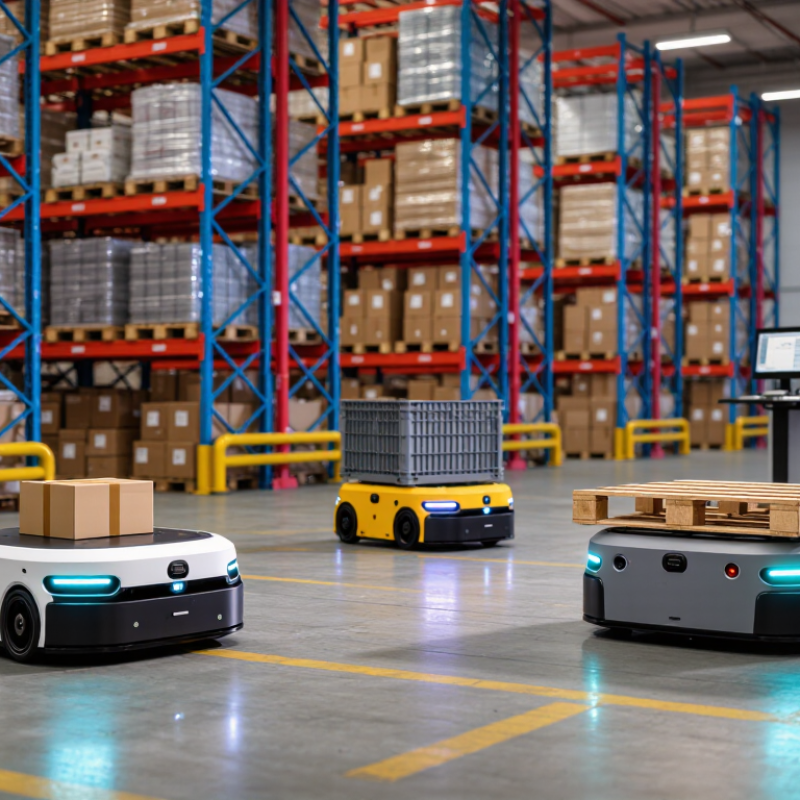
Autonomous mobile robots (AMRs) are self-guided machines that move goods through workplaces such as warehouses and factories. They use sensors, onboard software, and digital maps to understand their surroundings and choose routes. A lidar scanner may detect a pallet edge, while cameras or other sensors help identify nearby people and obstacles. Not magic. The robot must continually interpret changing conditions, not just follow a fixed line painted on the floor.
Unlike many traditional automated guided vehicles, AMRs can adjust their paths when an aisle is blocked. A worker crossing the route may prompt the robot to slow down, stop, or navigate around them, depending on its system and setup. That matters. In practice, safe and reliable operation also depends on clear traffic rules, suitable floor conditions, and thoughtful integration with doors, lifts, and warehouse software. Teams should test real tasks, including busy shifts and narrow turns, before estimating productivity gains. A mapped route can still behave less predictably than expected when people or stock patterns change. That is a limitation worth reviewing, not ignoring.
China’s AMR industry has developed within a fast-expanding automation ecosystem. The International Federation of Robotics reported 276,288 industrial robot installations in China in 2023, representing 51% of global installations. This figure does not measure AMRs specifically. It does, however, show the scale of the industrial environment supporting automation suppliers, integrators, and factory users. The shift is practical. Warehouses and production sites increasingly need robots that can move between work areas without fixed tracks. That requires reliable navigation, safe obstacle handling, and software that connects with existing workflows.
Demand is also part of a wider global trend. IFR’s World Robotics 2024 report recorded about 113,000 professional service robots sold for transportation and logistics worldwide in 2023, up 35% year over year. These figures include more than AMRs, so they should not be read as China’s AMR sales. The picture is not perfectly tidy: reports use different definitions for AMRs, AGVs, and logistics robots. For buyers, a specification sheet matters less than a site trial. Check how a unit handles narrow aisles, changing loads, and weak network coverage. Performance can vary, and published market totals rarely reveal those details.
When evaluating Chinese AMR manufacturers, compare more than advertised speed or payload. Ask for test records from routes similar to your facility, including narrow aisles, reflective floors, and busy crossings. A robot that performs well in a showroom may hesitate beside a shifting pallet. Small details matter.
Confirm payload capacity at the required travel speed. Check turning space, lift height, battery life, and charging behavior across a full shift. Review how the fleet software handles blocked routes, Wi-Fi gaps, and handoffs with warehouse systems. Request a live pilot, not only a scripted demo. Measure task completion, manual interventions, and recovery time. These numbers expose weaknesses.
Also assess deployment experience, technical documentation, spare-part availability, and response times in your operating region. Ask who diagnoses faults after installation and whether operators receive practical training. A low purchase price can hide integration or maintenance costs. Still, cost estimates are projections; site conditions often change. Compare written service commitments and realistic references from similar facilities before making a decision.
Ten Chinese AMR robot manufacturers can serve very different operational needs, so global buyers should compare capabilities rather than rely on a ranked list. A warehouse moving cartons needs different features from a production line carrying heavy components. Check payload, turning radius, floor tolerance, charging method, and performance around people. These details affect daily work.
Ask each manufacturer for a clear site-assessment process and a realistic deployment schedule. Request demonstrations using loads, aisle widths, and routes similar to your facility. A polished demo is not proof. Review how the fleet software handles blocked paths, traffic peaks, and manual intervention. Ask who provides commissioning, operator training, spare parts, and remote support in your region. Details matter. Also check technical documents, maintenance instructions, and available safety information before making comparisons. Avoid assuming that every system integrates smoothly with existing warehouse software; request a defined integration scope and test it.
A pilot can reveal issues that sales materials miss, such as weak wireless coverage or uneven floors. Record travel time, task completion, and recovery after interruptions. Some figures may look less impressive in real conditions. That is useful evidence, not necessarily failure. Compare total operating requirements alongside the purchase price, and leave room for questions that your team has not resolved yet.
Growth in professional service robot sales for transportation and logistics, 2023 vs. 2022
The International Federation of Robotics reported that sales of professional service robots for transportation and logistics grew by 35% in 2023, reaching about 113,000 units. This sector-wide figure provides market context for buyers evaluating AMR suppliers; it is not an AMR-only statistic or a comparison of individual manufacturers.
Source: International Federation of Robotics, World Robotics 2024 — Service Robots.
For international buyers, an AMR quotation is only the starting point. Confirm the export scope in writing: robot configuration, charging equipment, spare parts, packaging, and commissioning support. Ask for the shipping dimensions and gross weight before booking freight. A compact robot can still require a large crate. Small details matter.
Integration deserves equal attention. Share a layout with aisle widths, floor conditions, payloads, and pickup points before requesting a final design. Ask how the fleet communicates with warehouse software and what happens if the network drops. Request a factory acceptance test using representative tasks, not only a smooth demonstration route. Define delivery documents, manuals, and operator training in the contract. These checks reduce surprises, though they cannot remove every site-specific issue.
After-sales support should be measurable. Clarify response hours across time zones, remote diagnostic access, escalation steps, and the availability of replacement wheels, sensors, and batteries. Confirm whether local technicians can be trained and which repairs require factory assistance. A low purchase price may look attractive, but slow parts supply can leave a robot idle. Buyers should also budget time for commissioning; even a well-prepared system may need route tuning after real traffic begins. Some plans will need revision. That is worth admitting early.
Buyer comparison framework: This table ranks ten evaluation factors, not individual manufacturers. Supplier-specific capabilities, certifications, export experience, and service coverage should be confirmed directly; no company or brand data is presented.
| No. | Evaluation factor | What international buyers should verify | Why it matters |
|---|---|---|---|
| 1 | Application fit and payload | Request the rated payload, load dimensions, travel speed, turning requirements, floor conditions, ramp limits, and cycle-time assumptions for the proposed configuration. Ask for test results using a load representative of the actual application. | Published capacity alone does not establish suitability. Load shape, center of gravity, route conditions, and throughput requirements affect safe and reliable operation. |
| 2 | Safety and risk documentation | Ask for the machine risk assessment, safety-function documentation, emergency-stop and protective-field details, and the standards applied. ISO 3691-4 addresses safety requirements and verification for driverless industrial trucks and their systems; confirm its applicability to the proposed installation. | Safety compliance depends on the equipment and its operating environment. A standards reference alone is not proof that a complete site installation is compliant. |
| 3 | Navigation and site adaptability | Confirm the navigation method, mapping and commissioning process, behavior around people and moving obstacles, recovery after localization loss, and performance under the site's lighting and floor conditions. | A successful demonstration in a controlled area may not reflect performance in a busy facility with changing layouts, reflective surfaces, or mixed traffic. |
| 4 | Fleet management and integration | Request interface documentation and confirm supported connections to warehouse or manufacturing systems, traffic management, elevators, automatic doors, and charging equipment. Define ownership of software changes and integration testing. | System-level interoperability and agreed responsibility for integration are essential to avoid delays and unplanned custom engineering. |
| 5 | Export documentation and destination requirements | Confirm the proposed Incoterms® rule and named place, packing and shipping method, commercial invoice and packing-list arrangements, country-of-origin documentation where applicable, and the destination market's conformity and import requirements. | Import rules and product obligations vary by destination and configuration. CE marking, where relevant, is a conformity-marking framework—not a universal approval for every market. |
| 6 | Electrical and communications compatibility | Verify charging input requirements, plug and connector types, battery configuration, wireless network requirements, supported communication protocols, and any local radio-equipment requirements. | Confirming these details before shipment reduces installation changes and helps ensure the equipment can communicate with the site's infrastructure. |
| 7 | Commissioning and acceptance testing | Agree on the commissioning scope, site-readiness checklist, training, test routes, acceptance criteria, performance measures, and procedures for recording and resolving defects. | Written acceptance criteria make it clearer when installation is complete and how operational performance will be evaluated. |
| 8 | Warranty and after-sales support | Check warranty duration and exclusions, response hours and channels, remote diagnostic access, escalation procedures, availability of local service partners, and whether support is available in the required language and time zone. | A stated warranty does not by itself define service response, on-site coverage, or the party responsible for troubleshooting and repair. |
| 9 | Spare parts and lifecycle support | Request a recommended spare-parts list, parts ordering process, lead-time commitments where available, product-change notification policy, software-update policy, and expected support arrangements for discontinued components. | Parts availability and lifecycle planning affect maintainability and the long-term operating cost of a deployed fleet. |
| 10 | Commercial terms and total cost | Compare the complete scope: robots, software licences, integration, installation, training, freight, duties and taxes, spare parts, support, and any recurring fees. Clarify payment milestones, delivery assumptions, and remedies for schedule or acceptance issues. | Comparing equipment prices alone can omit significant project and ownership costs. A clearly defined scope supports a more meaningful supplier comparison. |
It is a self-guided machine that moves goods through places like warehouses and factories. Sensors, software, and digital maps help it choose routes.
It may slow down, stop, or navigate around a person or blocked aisle. It still needs suitable floors and clear traffic rules. Not magic.
Compare payload, turning radius, floor tolerance, charging method, and performance around people. A carton route and a heavy-component route need different features.
Use realistic loads, narrow aisles, and routes from your facility. Test busy periods and interruptions, too. A smooth demo proves little.
Record travel time, completed tasks, and recovery after interruptions. Check wireless coverage and uneven floors. Some results may disappoint; that is useful evidence.
Confirm the robot configuration, charging equipment, spare parts, packaging, and commissioning support in writing. Ask for crate dimensions and gross weight before arranging freight.
Share aisle widths, floor conditions, payloads, and pickup points. Ask what happens when the network drops, then test the agreed integration scope.
Define response hours, remote diagnostics, escalation steps, and replacement-part availability. Confirm which repairs local technicians can handle. Plans may need revision. That happens.
This article introduces Autonomous Mobile Robots (AMRs), explaining how they navigate changing environments and support material handling across warehouses, factories, and other operations. It also traces the development of China’s AMR manufacturing industry, from growing technical capabilities to a wider range of systems designed for different workflows and operating needs.
For global buyers, the article outlines practical criteria for comparing Chinese AMR Robot manufacturers, including navigation performance, payload capacity, safety features, software compatibility, customization, and service support. It presents ten manufacturers as options to evaluate, without treating any one supplier as a universal fit. The final section considers export arrangements, system integration, spare parts, training, and after-sales service—factors that can shape the long-term success of an AMR deployment.