8 Warehouse Robots for Las Vegas Intralogistics and OEM Programs
Compare production models by payload, lift, navigation, and deployment role. Every unit can be specified for OEM branding, custom top modules, fleet scheduling, and WMS/MES integration. For a site-specific recommendation, send your aisle, rack, pallet, throughput, and shift data with the quote request.
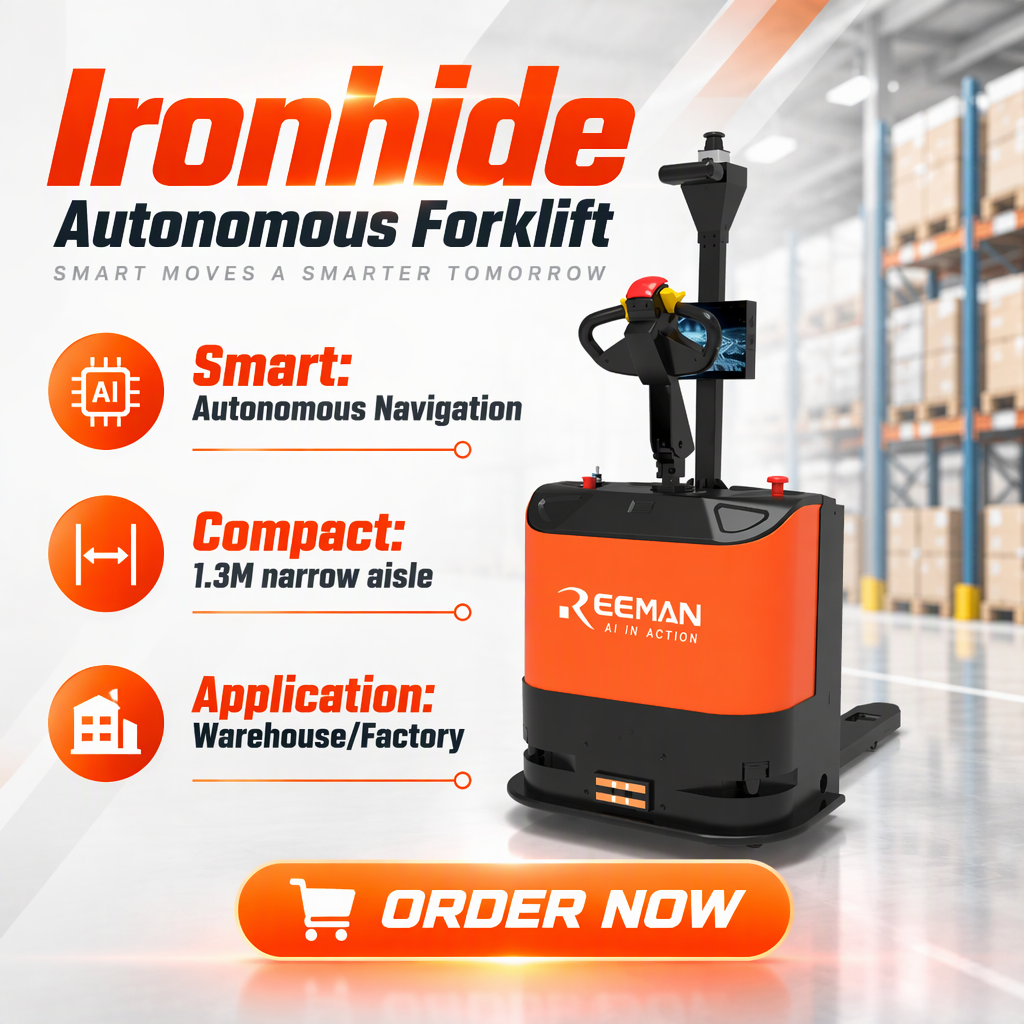 1.5 Ton
Reeman 1.5 Ton Autonomous Forklift AGV 3D Obstacle Avoidance Bidirectional Driving 48V 30AH Lithium-Ion Battery
A practical pallet-handling robot for dock-to-staging, replenishment, and production-line feeding where bidirectional travel reduces turning time.
View product specs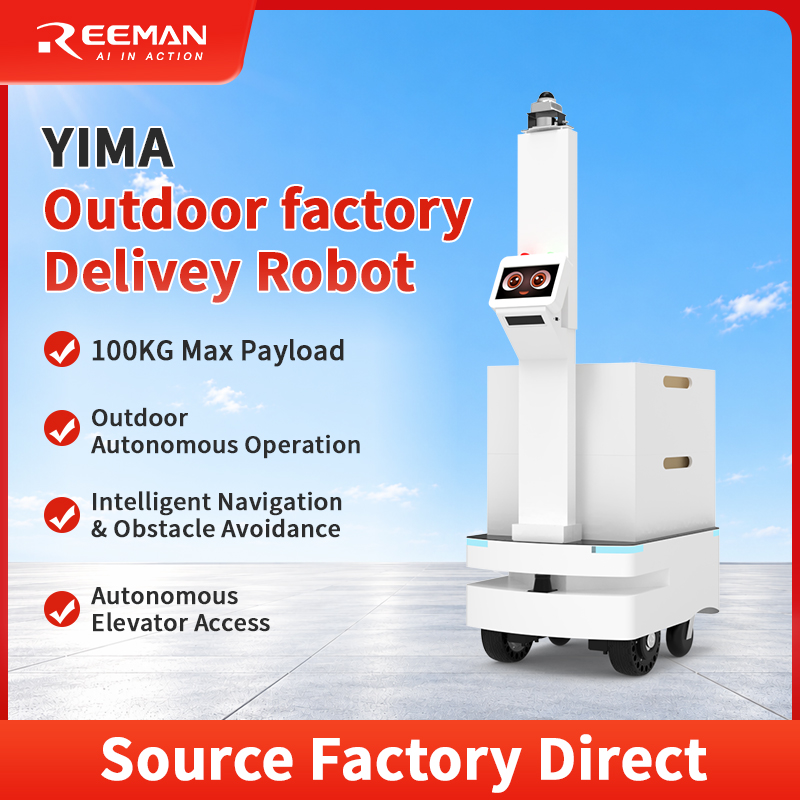 100 kg
REEMAN Outdoor Delivery Robot 100kg Payload Autonomous Navigation Obstacle Avoidance Elevator Access Warehouse Logistics
Designed for campus-style delivery, warehouse-to-office transfers, and hospitality logistics where elevator access and autonomous obstacle avoidance are required.
View product specs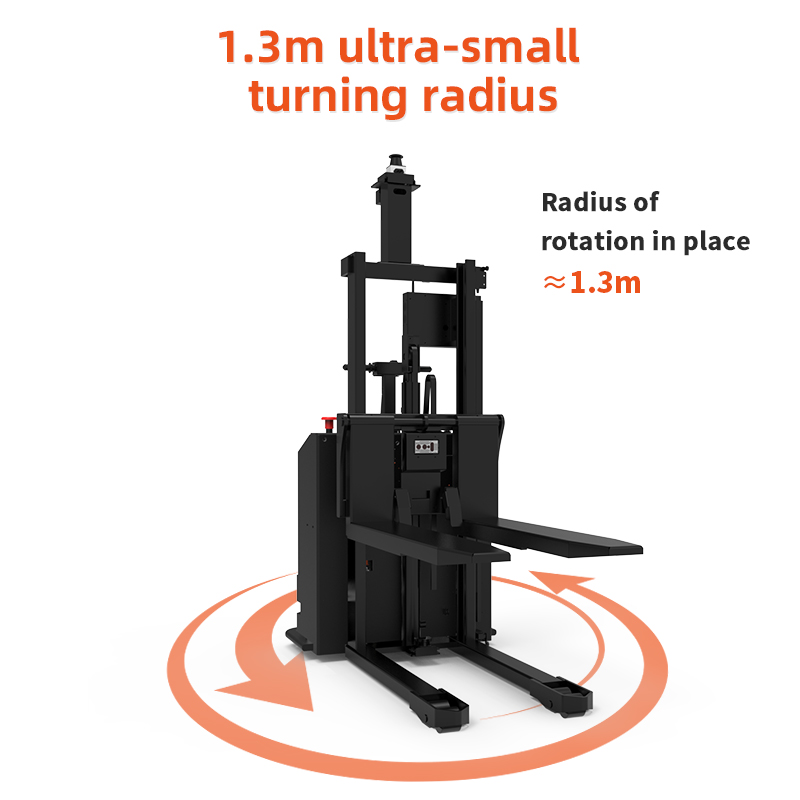 1000 kg
1000kg Forklift AGV Laser SLAM Navigation Pallet Transport Robot 1.3m Turning Radius Auto Charging for Factory Logistics
A compact turning radius and automatic charging make this model suitable for multi-shift factory logistics and warehouse zones with limited maneuvering space.
View product specs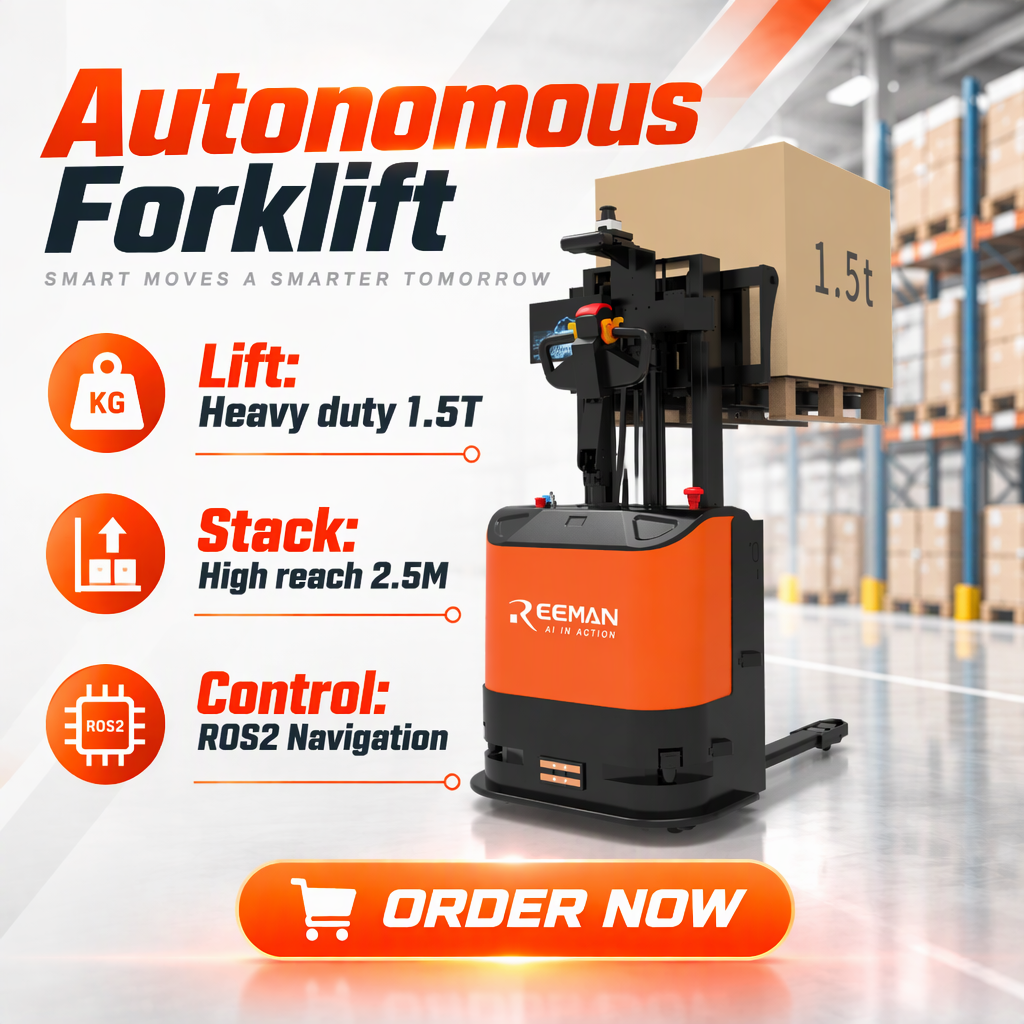 1500 kg
Autonomous Electric Forklift AGV 1500kg Load Capacity 2.5M Lift ROS2 Navigation 4WD Lithium-Ion Battery Indoor Material Handling
Built for indoor material handling with 2.5 m lift, four-wheel drive, and ROS2 navigation for higher-level integration and repeatable pallet movement.
View product specs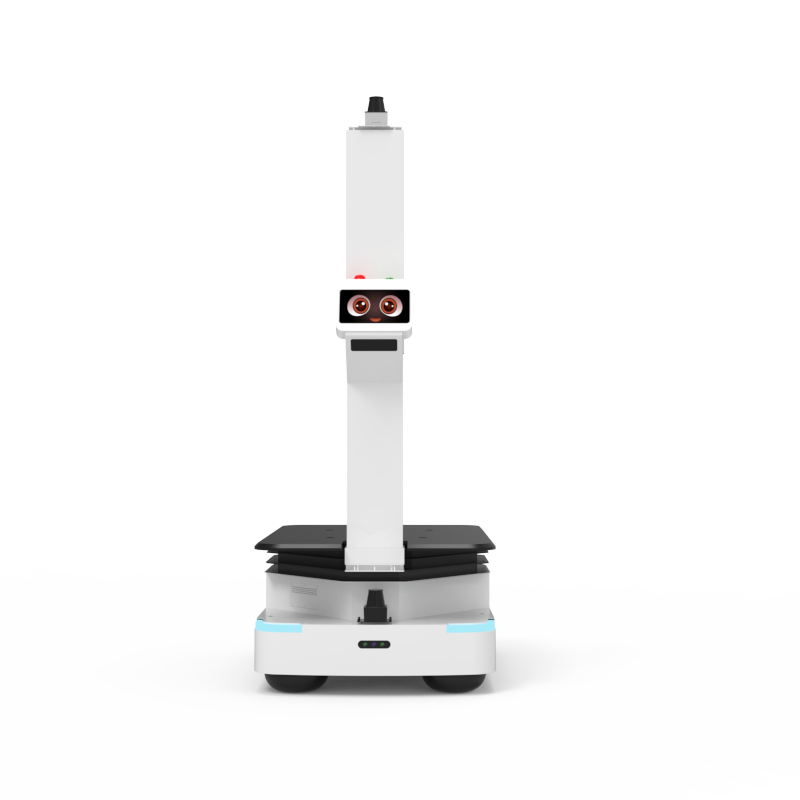 600 kg
600kg Industrial AMR AGV Robot Laser SLAM Navigation QR Code-Free Factory Logistics
A QR code-free AMR for flexible factory logistics, line-side replenishment, and internal transfers where layout changes must not require floor markers.
View product specs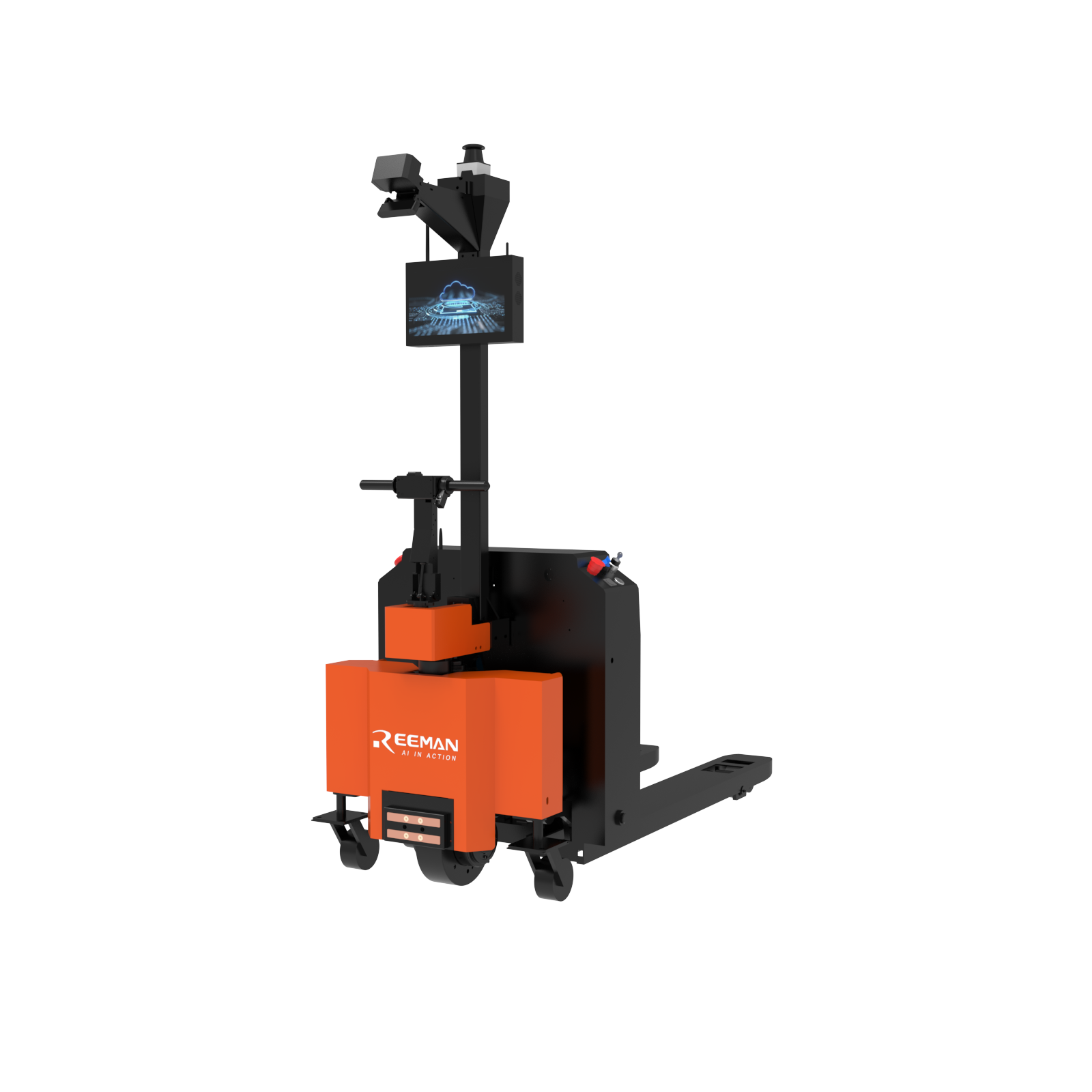 2 Ton
REEMAN X-ant JBOT20F 2 Ton Autonomous Forklift AGV Laser SLAM Pallet Handling Robot for Warehouse Logistics
A heavier-duty autonomous forklift for warehouse logistics, long shifts, and pallet flows where payload and route stability drive fleet sizing.
View product specs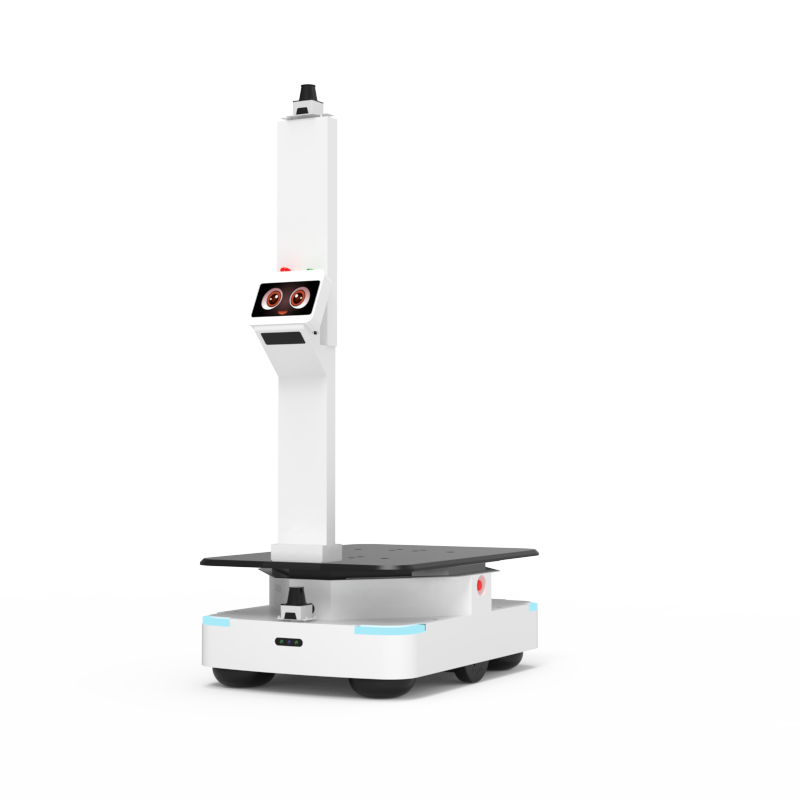 Lifting AMR
600kg Payload Laser Navigation AMR Robot Autonomous Lifting Warehouse Transfer Equipment
A lifting AMR platform for container, cart, and shelf transfer inside warehouses where flexible docking and autonomous navigation matter.
View product specs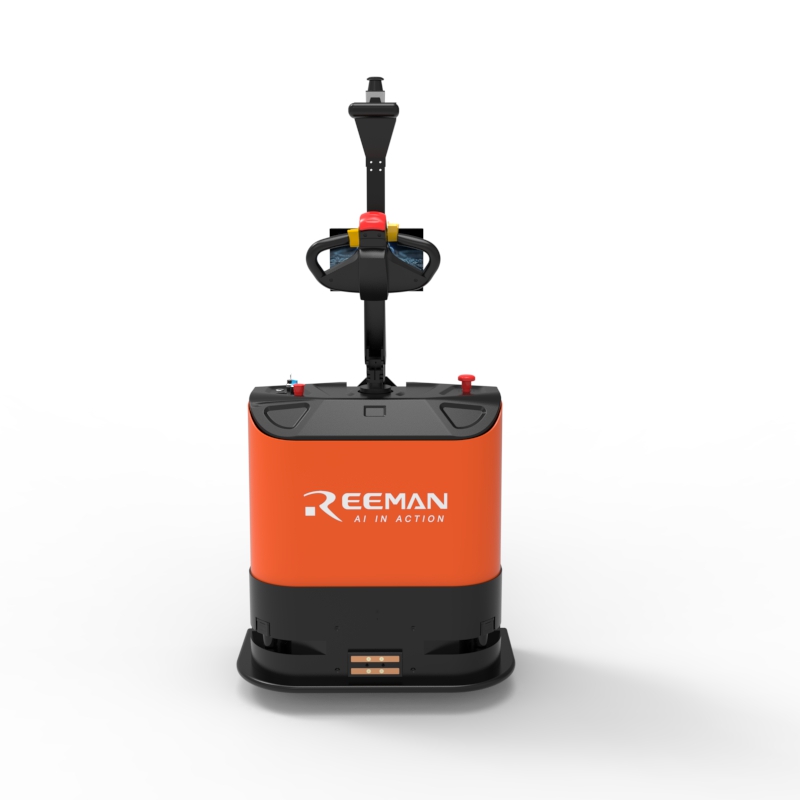 1500 kg
1500kg Laser SLAM Autonomous Forklift AGV Reflector-Free Point-to-Point Warehouse Material Handling
A reflector-free autonomous forklift for point-to-point material handling, useful where temporary layouts and changing routes make fixed infrastructure costly.
View product specsA Production Partner Behind Your Las Vegas Robot Program
Procurement teams need evidence, not brochure language. Elvorn was founded in 2015 and has developed in-house laser SLAM navigation, motion control, fleet scheduling, and robot hardware. Our production footprint covers Shenzhen and Ningbo, and our team supports OEM, design-service, and buyer-label programs for export markets.
Use these facts as due-diligence inputs. The factory has been verified onsite by SGS Group, management systems are certified to ISO 9001 and ISO 14001, and model-level marks include CE, FCC, and PSE. For Las Vegas projects, request serial-number-linked test records, spare-parts lists, and software integration documentation before issuing a purchase order.
Core Advantages for Las Vegas OEM and Warehouse Buyers
The strongest robot program is not simply the lowest purchase price. It is the configuration that maps quickly, integrates cleanly, supports safe mixed traffic, and keeps spare parts available after commissioning.
Laser SLAM Without Fixed Floor Work
Elvorn robots map the site with laser SLAM and navigate without magnetic tape, QR codes, or reflectors. That matters in Las Vegas buildings where leases, rack layouts, and temporary event spaces change quickly.
Open SDK and API Integration
AMRs and chassis platforms support secondary development so integrators can connect robots to WMS, MES, ERP, elevators, doors, and custom dashboards. Task dispatch and status feedback can be reviewed before deployment.
Modular Payload Platforms
From 100 kg delivery robots to 1.5-ton and 2-ton autonomous forklifts, shared control architecture can simplify operator training, fleet rules, and maintenance planning across mixed sites.
Multi-Layer Safety Architecture
Lidar, obstacle sensors, emergency stops, and speed zoning support safer mixed traffic around pedestrians, forklifts, and racking. Site-specific safety validation should always involve qualified local reviewers.
Custom OEM and Buyer-Label Service
OEM service includes custom top modules, payload structures, branding, packaging, and documentation. For distributors and technology brands, a proven chassis can shorten development time versus engineering from a blank sheet.
Export-Ready Commercial Support
Elvorn supports export orders with English documentation, remote commissioning, spare-parts planning, and FOB trade terms. Payment is accepted by T/T in USD or CNY for approved orders.
Las Vegas Application Scenarios: Where the Work Actually Happens
Las Vegas is a logistics and hospitality market, not a generic warehouse city. The same robot program may need to support a 3PL in North Las Vegas, a manufacturer in Henderson, and a resort back-of-house team near the Strip. These are the most common high-value use cases.
Resort and Hospitality Back-of-House
Autonomous delivery robots and AMRs can move linens, food and beverage supplies, amenities, and internal parcels along service corridors. Night-shift schedules, guest safety, and elevator access should be reviewed before route mapping.
Fulfillment and Distribution Centers
Autonomous forklifts support pallet put-away, replenishment, dock-to-staging, and cross-docking. In peak seasons, fleet size and charging strategy matter more than a single robot’s top speed.
Convention and Event Logistics
Temporary layouts and move-in/move-out schedules make fixed floor infrastructure impractical. Laser SLAM robots and outdoor delivery robots can reduce repeated manual transport when routes change frequently.
Factory and Building-Products Supply
Manufacturers in Henderson, North Las Vegas, and nearby industrial corridors can use 600 kg to 2-ton platforms for line-side feeding, work-in-process movement, and finished-goods transfer.
Dock, Racking, and Cold-Chain Support
Pallet transport between dock, staging, and racking can be standardized with autonomous forklifts. For cold or freezer transitions, validate battery performance, condensation, floor conditions, and maintenance access.
Custom Robot Development for Nevada Brands
Integrators and OEM brands can start from proven SLAM chassis, then add their own top module, software layer, branding, and service model. Open SDK support reduces the risk of a custom build.
Las Vegas Warehouse Robot Trends to Watch in 2025–2026
The buying conversation has shifted from “Can a robot move a pallet?” to “Can the fleet prove safety, uptime, integration value, and serviceability inside a live site?” These trends should shape your next RFQ.
Brownfield-First Automation
High land and construction costs favor retrofits over new facilities. Laser SLAM mapping and minimal floor work are practical advantages in existing warehouses, but Wi-Fi, lighting, floor flatness, and traffic rules must still be validated.
Multi-Robot Orchestration
Buyers are moving from single-robot trials to fleet deployments. Ask for API documentation, task audit logs, incident records, and clear responsibility boundaries between the robot, WMS, and local controls.
24/7 Labor Flexibility
Hospitality and logistics operations run around the clock. Opportunity charging, autonomous charging docks, remote diagnostics, and spare-parts planning are now part of the ROI conversation, not afterthoughts.
Heat, Dust, and Safety Validation
Las Vegas operations may combine conditioned warehouses with hot docks and dusty yards. Do not assume indoor robots are outdoor-rated. Review environmental limits, battery thermal management, filter service, and safety responsibilities with qualified site reviewers.
A realistic Las Vegas business case should separate controllable costs, such as labor, downtime, and product damage, from site constraints, such as aisle width, Wi-Fi dead zones, floor flatness, elevator access, and mixed pedestrian traffic. Request a route study or simulation before committing to a large fleet. For export projects, lock documentation, spare parts, training, and remote support into the same commercial scope. This is where an experienced OEM manufacturer and exporter adds measurable information gain compared with a catalog-only supplier.
What to Send for a Las Vegas-Specific Robot Quote
A precise RFQ shortens engineering review and reduces the risk of specifying the wrong robot family. Share the following data with your quote request rather than asking only for a price list.
Facility Data
Floor plans, aisle widths, rack heights, dock details, floor condition, Wi-Fi coverage, elevator and door controls, temperature range, dust exposure, and any mixed pedestrian or forklift traffic zones.
Workflow Data
Load weight, pallet or container type, pick-up and drop-off points, throughput per hour, shift pattern, peak-season profile, exception handling, and safety rules for people and equipment.
Commercial Data
OEM branding, custom top module, target in-service date, destination port or city, import terms, spare-parts expectations, operator training, documentation language, and preferred payment currency.


From Shenzhen and Ningbo to Las Vegas
As a custom manufacturer, Elvorn supports OEM service, design service, and buyer-label programs, including custom top modules, payload structures, branding, and packaging. For Las Vegas buyers, the practical value is a production partner that can discuss navigation, safety, integration, and export documentation in one engineering conversation.
Export terms are FOB, with T/T payment in USD or CNY for approved orders. Main export markets include North America, Western Europe, Eastern Asia, Southeast Asia, and the Middle East. English documentation, remote commissioning, and long-term spare-parts supply are part of the support model for distributors and integrators.
If your business model needs a differentiated robot, start with a proven SLAM platform rather than a blank sheet. That approach can reduce development risk while preserving your brand, software layer, and application-specific top module.
Las Vegas Buyer FAQ: Warehouse Robots, OEM, and Export
These are the procurement questions we recommend clarifying before comparing quotations. They help separate a credible OEM warehouse robot program from a one-time equipment sale.
Are you a local Las Vegas manufacturer or an exporter serving Las Vegas?
Elvorn is a custom OEM robot manufacturer with production bases in Shenzhen and Ningbo, China, exporting to Las Vegas and Nevada buyers. We support remote engineering, documentation, and coordination with local service or integration partners where appropriate. Be explicit about whether your project requires an onsite local service presence, because support models vary by contract and robot fleet size.
Can Elvorn build a custom OEM warehouse robot for our brand?
Yes. OEM and ODM programs can include custom top modules, payload structures, battery and charging configuration, branding, packaging, documentation, and software interfaces. As a verified custom manufacturer, Elvorn can support buyer-label programs for distributors and integrators serving North America.
How do robots connect to WMS, MES, ERP, elevators, and doors?
AMRs and robot chassis provide open SDK and API options for secondary development. Integration can include task dispatch, status feedback, elevator access, door control, and custom dashboards. For Las Vegas projects, document who owns the WMS interface, who commissions the network, and who validates exception handling before go-live.
Will autonomous forklifts handle Las Vegas heat and dusty sites?
Indoor warehouse robots must be applied within their validated environmental envelope. For hot or dusty docks, specify operating temperature range, battery thermal management, filtration, charging location, and maintenance intervals. Do not assume an indoor autonomous forklift is outdoor-rated. Outdoor delivery robots have different limits and should be reviewed separately with site temperature, dust, and route data.
What certifications and safety documents support procurement?
Depending on the model, Elvorn robots carry CE, FCC, or PSE marks. The management system is certified to ISO 9001 and ISO 14001, and the factory has been verified onsite by SGS Group. A Las Vegas deployment may also require site-specific safety review, local authority coordination, and compliance with applicable driverless industrial vehicle standards. Ask for model-level certificates, test records, and the spare-parts list.
What should we send to get an accurate quote and lead time?
Send your floor plan, pallet or load data, throughput target, shift pattern, environmental conditions, destination, OEM branding requirements, and preferred trade terms. Lead time depends on configuration, customization scope, and current production slot. A complete RFQ lets our engineers recommend the right robot model, fleet size, charging strategy, and export plan before you commit to a purchase order.
Build a Las Vegas-Specific OEM Warehouse Robot Program
Send your floor plan, load data, throughput target, shift pattern, and branding requirements. Elvorn will return a model recommendation, customization scope, export plan, and next-step checklist. For urgent projects, include your target in-service date and preferred port of entry.