Top Trusted Industrial AGV Robot Factories & Suppliers for the Mexico Market
A practical, factory-verified guide for Mexican manufacturers, 3PLs, integrators, and industrial distributors evaluating laser SLAM autonomous forklifts, AMRs, lifting robots, and pallet-handling AGVs for nearshoring operations.
8 Industrial AGV and AMR Models Recommended for Mexico Operations
The eight configurations below cover the material-flow gaps most often found in Mexican automotive, electronics, appliance, food and beverage, logistics, and industrial-distribution facilities: 300 kg line-side delivery, 1 ton to 2 ton pallet handling, autonomous stacking, lifting, and warehouse transport. Each model preserves its original product URL for technical review.
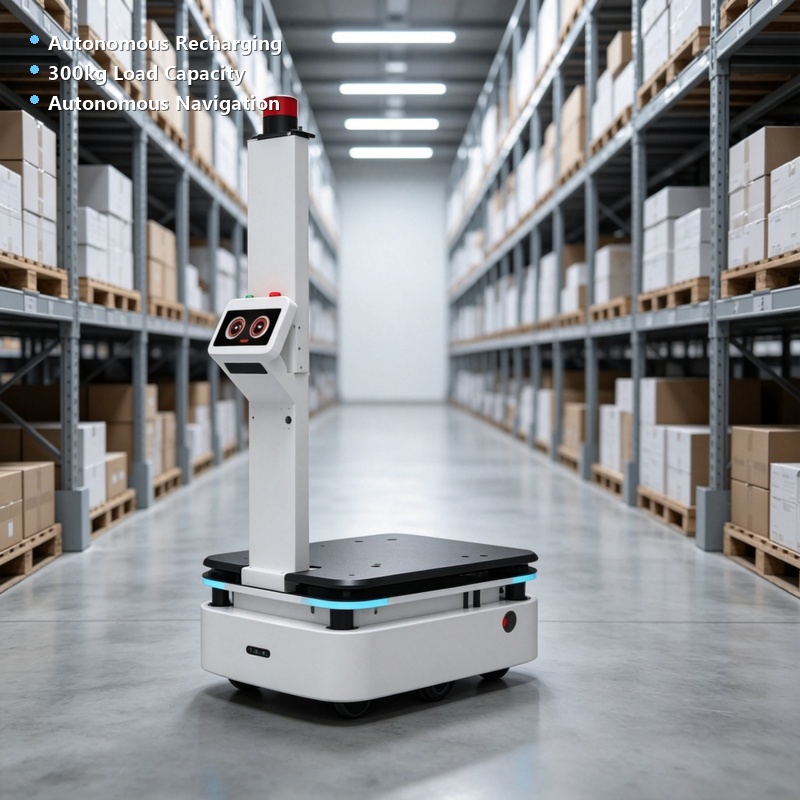
REEMAN Dual Laser Fly Boat MAX 300kg Industrial Delivery Robot for Manufacturing Plants and Factory Material Supply
Well suited to high-mix electronics, appliance, and auto-parts plants where small loads move frequently between kitting, assembly, and inspection points without fixed floor infrastructure.
View specifications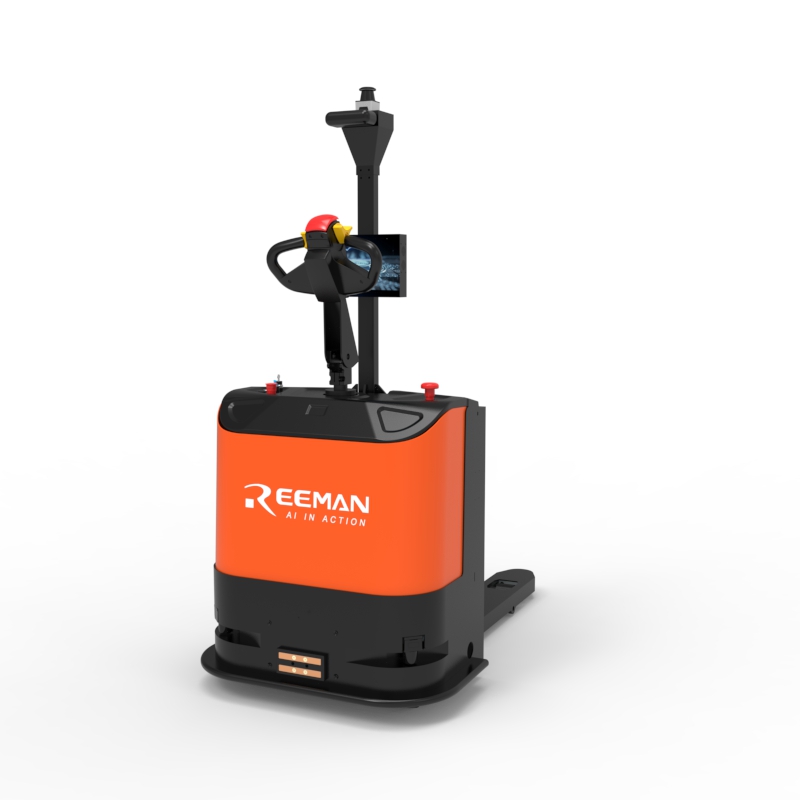
1500kg Laser SLAM AGV Forklift Single Line Lidar 30mm Navigation Accuracy 1019mm Forks 570mm Width Industrial Handling
A practical starting point for Mexican warehouses and production plants that need repeatable pallet movement from receiving and storage to line-side staging with narrow-fork access.
View specifications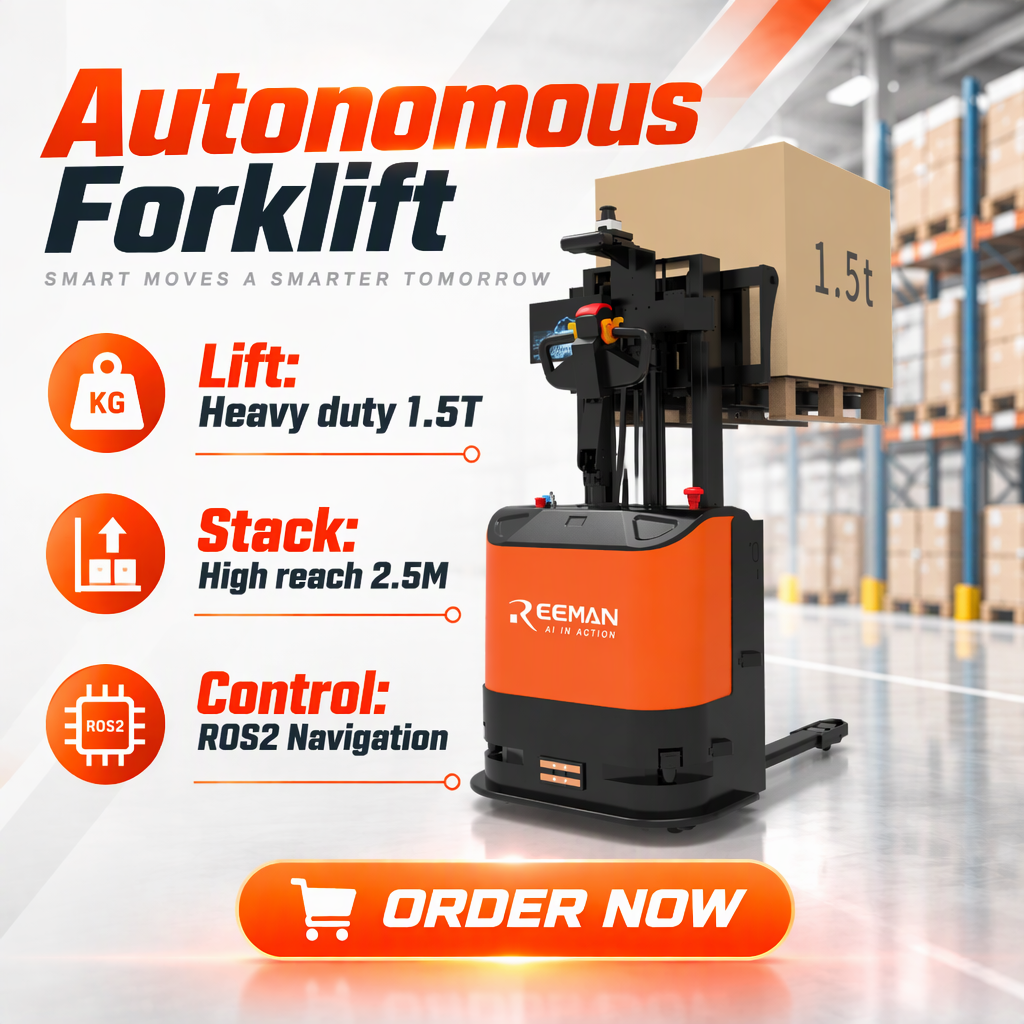
Autonomous Electric Forklift AGV 1500kg Load Capacity 2.5M Lift ROS2 Navigation 4WD Lithium-Ion Battery Indoor Material Handling
Designed for indoor operations that combine pallet transport with 2.5 m lift tasks; ROS2 navigation and lithium-ion battery configuration support engineering integration and multi-shift planning.
View specifications
Reeman BBOT30F 1500kg Laser SLAM Autonomous Pallet Stacker AGV Single Line Lidar Obstacle Avoidance Warehouse Transport
For facilities that need autonomous pallet stacking, low-rack replenishment, and warehouse transport while minimizing dependence on magnetic tape or fixed guide paths.
View specifications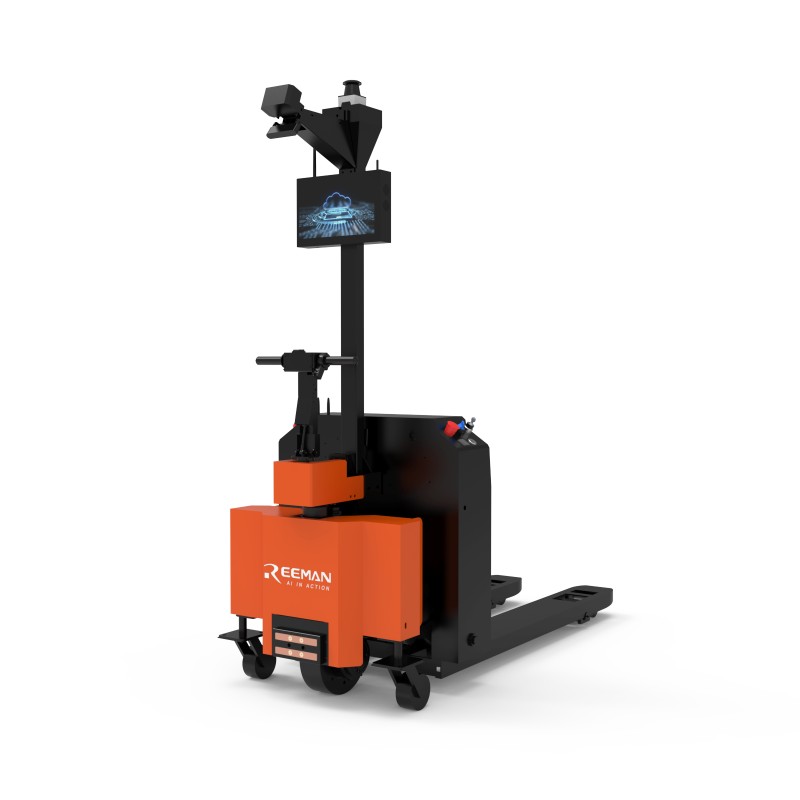
Reeman 2 Ton Autonomous Forklift AGV Laser SLAM Unmanned Pallet Truck 1085mm Fork 10mm Position Accuracy
Appropriate for heavier pallet flows in automotive, appliance, and 3PL environments where 10 mm positioning accuracy and repeatable dock-to-storage cycles matter.
View specifications
Dual Laser AMR 300KG AGV Lifting Mobile Robot with Slam LiDAR Navigation for Manufacturing Plants
Useful for cart, tote, and light pallet movement in dynamic corridors. The lifting platform supports flexible docking with existing carts or mobile racks, reducing retrofit scope.
View specifications
REEMAN Autonomous Electric Forklift 1T Payload 48V 30Ah LiFePO4 Battery Indoor Material Handling AGV
A compact electric forklift AGV for indoor handling where a one-ton payload, lithium-ion battery operation, and simpler fleet rollout are preferred over heavy forklift capacity.
View specifications
REEMAN X-ant JBOT20F 2 Ton Autonomous Forklift AGV Laser SLAM Pallet Handling Robot for Warehouse Logistics
Configured for warehouse logistics teams that need robust pallet handling, laser SLAM navigation, and a proven autonomous forklift platform for repetitive transport cycles.
View specificationsSupplier Credentials Behind This Industrial AGV Shortlist
The product range above is supported by Shenzhen Elvorn Intelligent Equipment Co., Ltd., a national high-tech enterprise founded in 2015 and focused on robotic platform technology, autonomous driving, and intelligent equipment. For Mexico buyers, the relevant question is not simply whether a factory can ship a robot; it is whether the supplier can document engineering depth, production capacity, quality management, export experience, and long-term support.
Mexico Industrial AGV Outlook: Nearshoring, USMCA, and the Shift to Flexible Automation
Mexico is no longer just a low-cost manufacturing backup. It is becoming a strategic production base for North American supply chains, and that change is increasing the value of flexible automation that can be redeployed as product lines, labor availability, and customer demand shift.
Nearshoring and USMCA create flexible-capacity pressure
Manufacturers expanding in Monterrey, Querétaro, the Bajío, Coahuila, and Nuevo León need to scale output without rebuilding fixed conveyor or guide-path infrastructure for every new program.
Labor turnover and forklift safety influence ROI
High turnover and mixed pedestrian-traffic environments make repetitive pallet runs a natural automation target. Laser SLAM robots can reduce unplanned stops and keep consistent cycle times across shifts.
Industrial clusters require localized support planning
Mexico’s manufacturing geography is not uniform. Buyers in Tijuana, Guadalajara, Mexico City, Puebla, or Saltillo need clear plans for Spanish-language operation, remote commissioning, spare parts, and escalation pathways.
Traceability is moving from option to requirement
Open SDK and API access allow AGV and AMR fleets to receive tasks from WMS, MES, ERP, or custom systems, making robot activity visible in the same production and warehouse data flows used by plant management.
Energy cost and 24/7 uptime shape battery decisions
Lithium-ion battery platforms, opportunity charging, and predictable maintenance intervals become commercial factors when plants run extra shifts to serve North American customers.
Supplier due diligence matters more than unit price
Verify whether the supplier is a factory, an integrator, or a trading company. SGS onsite verification, ISO 9001 and ISO 14001 systems, patent count, production bases, and export documentation provide useful evidence before a Mexico procurement committee approves capitalization.
Where Industrial AGVs Deliver ROI in Mexico
Mexico-specific ROI depends less on robot brochure speed and more on matching load, floor condition, aisle width, pallet quality, shift pattern, and operator workflow. The scenarios below are realistic starting points for solution scoping.
Automotive and auto-parts plants in the Bajío, Coahuila, and Nuevo León
Use 1.5 ton to 2 ton autonomous forklifts for dock-to-storage and line-side pallet flow, supported by 300 kg AMRs for small components and sequenced kits. Confirm pallet condition, racking tolerance, and pedestrian-zone safety rules early.
Electronics and appliance factories in Tijuana, Guadalajara, and Ciudad Juárez
Dual-laser AMRs and lifting mobile robots help move totes, carts, and light pallets through changing production layouts. Flexible navigation is valuable when product mixes change frequently and fixed guide paths would become obsolete.
Food and beverage operations in Jalisco, Puebla, and Veracruz
Autonomous pallet stackers and forklift AGVs can reduce repetitive pallet shuttling between production, staging, and dispatch. Buyers should separately confirm washdown, IP rating, and floor-cleaning requirements with the factory before configuration.
Warehousing and 3PL hubs in Mexico City, Monterrey, and Guadalajara
Warehouse operators can combine 2 ton autonomous forklifts, 1.5 ton pallet stackers, and open SDK integration with WMS tasks. The objective is not full lights-out operation; it is reducing empty travel, shift handover loss, and repetitive operator movement.
Industrial distributors and automation integrators
Local integrators can use robot chassis platforms and OEM/ODM support to build branded automation solutions for Mexican customers, adding top modules, Spanish HMI customization, and local service agreements while relying on the factory for core navigation technology.
Brownfield plants avoiding floor reconstruction
Laser SLAM navigation maps a site in hours and avoids magnetic tape, QR codes, or reflector installation for many layouts. This is especially useful when a Mexico plant needs automation without stopping production or damaging existing flooring.
Match a Mexico Workflow to the Right Industrial AGV Platform
Procurement teams should brief suppliers with a load diagram, layout drawing, throughput target, shift schedule, and integration requirement. The following matrix shows how the eight models may be shortlisted before a formal site survey.
| Buyer requirement | Recommended platform | Mexico-specific value | What to verify |
|---|---|---|---|
| 300 kg line-side delivery | REEMAN Dual Laser Fly Boat MAX 300kg Industrial Delivery Robot | Supports high-mix production and frequent layout changes in electronics, appliance, and auto-parts plants. | Cart / tote dimensions, floor slope, wireless coverage, and docking tolerance. |
| 1,500 kg pallet transport | 1500kg Laser SLAM AGV Forklift Single Line Lidar | Balances payload, narrow-fork access, and stable autonomous pallet movement for warehouses and production feeding. | Fork entry clearance, pallet condition, aisle width, and charging location. |
| 1,500 kg with 2.5 m lift | Autonomous Electric Forklift AGV 1500kg ROS2 Navigation | ROS2 navigation and lithium-ion battery planning fit engineering-led indoor projects with lift requirements. | Rack height, mast clearance, integration scope, and power-supply details. |
| Pallet stacking and low-rack storage | Reeman BBOT30F 1500kg Laser SLAM Autonomous Pallet Stacker | Autonomous stacking and transport reduce repetitive trips without fixed reflectors in many layouts. | Pallet quality, rack tolerance, floor flatness, and safety-zone design. |
| 2 ton heavy pallet handling | Reeman 2 Ton Autonomous Forklift AGV with 10 mm position accuracy | Designed for heavier flows where repeatable position accuracy and dock-to-storage consistency drive value. | Fork spreading, turning radius, load center, and traffic-management plan. |
| Lifting and cart handling | Dual Laser AMR 300KG AGV Lifting Mobile Robot | Flexible lifting platform can support carts, totes, and mobile racks with less floor retrofit. | Cart interface, docking repeatability, obstacle density, and WiFi handover. |
| Compact 1 ton indoor handling | REEMAN Autonomous Electric Forklift 1T Payload 48V LiFePO4 Battery | Lithium-ion operation and compact payload fit smaller plants and phased automation rollouts. | Charger voltage, battery cycle plan, floor capacity, and emergency-stop layout. |
| 2 ton warehouse logistics | REEMAN X-ant JBOT20F 2 Ton Autonomous Forklift AGV | Laser SLAM pallet handling for warehouse teams seeking repeatable transport and reduced forklift congestion. | Fleet size, task dispatch method, WMS/MES integration, and spare-parts plan. |
What Mexican Buyers Should Verify Before Approving an AGV Purchase
Experienced buyers do not treat the robot as an isolated machine. They evaluate the robot as part of an import, safety, maintenance, and data-integration system.
Electrical supply and charger compatibility
Confirm the site’s available voltage, frequency, phase, and charger location. Mexico commonly uses 127 V and 220 V configurations at 60 Hz, but industrial sites vary; the charger and power plan must be approved by the plant electrical team.
Floor, ramp, and aisle survey
Provide layout drawings, slope data, expansion joints, floor flatness, aisle width, door dimensions, elevator use, and people / forklift traffic. These inputs determine navigation performance and safety-zone design.
Spanish-language operation and training
Ask for Spanish HMI requirements, operator documentation, maintenance checklists, and training plans. For Mexico plants, language fit can determine whether the robot is actually used on the floor after acceptance.
Customs, import classification, and NOM review
Engage a qualified customs broker and local regulatory advisor. Verify HS classification, import documentation, electrical safety, and any NOM-STPS or other requirements that apply to the equipment and installation.
WMS, MES, and ERP integration scope
Open SDK and API access are valuable, but the project still needs interface definitions, task-dispatch rules, status feedback, exception handling, and acceptance testing with the plant IT team.
Service plan, spare parts, and escalation
Agree on spare-parts recommendations, remote diagnostic process, training documentation, warranty terms, and escalation contacts before shipment. For OEM buyers, include custom top-module and buyer-label scope.
From RFQ to Stable Operation in Mexico
A disciplined five-step path reduces deployment risk for overseas buyers and gives procurement, engineering, and operations teams a shared acceptance framework.
Requirement review
Share load data, pallet and cart dimensions, layout drawings, throughput target, shift schedule, and existing equipment.
Site and safety review
Review aisle width, floor condition, traffic, charging area, WiFi coverage, pedestrian zones, and emergency-stop planning.
Configuration and customization
Confirm model, fork size, mast height, lifting module, battery plan, language requirement, OEM branding, and software interfaces.
Factory testing
Run functional and load tests before shipment, and request test records for acceptance documentation where required.
Export and remote deployment
Coordinate FOB shipment, customs documentation, remote mapping support, operator training, and spare-parts planning.
Why a Verified Industrial AGV Factory Lowers Procurement Risk
Mexican procurement teams often compare landed price first, then discover that integration, language support, spare parts, and engineering responsiveness dominate lifecycle cost. A factory with in-house navigation technology and production control can answer those questions with evidence rather than assumptions.



Deep experience in autonomous forklifts, AMRs, robot chassis, delivery robots, cleaning robots, and disinfection robots
Elvorn designs, builds, and supports a broad portfolio of intelligent equipment rather than reselling unrelated catalog items. The company operates two production bases in Shenzhen and Ningbo and maintains in-house R&D across laser SLAM navigation, motion control, fleet scheduling, and hardware. That breadth is useful for Mexican buyers because a single project may require an autonomous forklift for pallet flow, a 300 kg AMR for line-side delivery, and a chassis platform for an integrator’s custom solution.
The company offers OEM service, design service, and buyer-label options, including custom top modules, payload structures, branding, and packaging. For distributors and integrators in Mexico, this can shorten time-to-market while keeping the core navigation platform proven and supportable.
Export terms include FOB and T/T payment in USD or CNY, with experience serving buyers in North America, Western Europe, Eastern Asia, Southeast Asia, and the Middle East. Quality management is certified to ISO 9001 and ISO 14001, the factory has been verified onsite by SGS Group, and individual models may carry CE, FCC, or PSE marks depending on configuration.
- Founded in 2015 with 11+ years in the robotics industry
- 39 patents and a 200+ member team
- 5,200㎡ total floorspace across two production bases
- Laser SLAM navigation without mandatory magnetic tape
- Open SDK and API for WMS, MES, ERP, or custom integration
- OEM, ODM, design service, and buyer-label options
- ISO 9001 and ISO 14001 management systems
- SGS onsite verification and model-level CE / FCC / PSE marks
Certifications and Evidence Mexican Buyers Can Review
Certification requirements depend on the model, installation, and use case. Use these credentials as starting points for due diligence, then confirm the exact configuration with the factory and your local compliance advisor.
 SGS Onsite Verified
 CE Marking
 FCC
 PSE
Frequently Asked Questions About Industrial AGV Procurement in Mexico
These are the questions we recommend Mexican buyers ask before shortlisting a factory, signing a purchase order, or committing to a pilot installation.
Which industrial AGV should a Mexican automotive plant start with?
For pallet-heavy flows, start with a 1.5 ton or 2 ton autonomous forklift AGV and validate aisle width, pallet condition, rack tolerance, and dock-to-line distance. For small components, totes, or sequenced kits, a 300 kg dual-laser AMR or lifting mobile robot may be more flexible. The final recommendation should follow a site survey rather than a catalog comparison alone.
Can the robot operate with 127 V or 220 V power in Mexico?
The robot itself is battery-powered, but the charger and charging area must match the plant’s actual electrical supply. Mexican industrial sites may use different voltage, phase, and frequency configurations, so provide the charger location, supply details, and electrical safety requirements during quotation. The factory should confirm the charger specification in writing before shipment.
Which certifications should a Mexican buyer verify?
Verify model-level CE, FCC, or PSE marks where applicable, ISO 9001 and ISO 14001 management-system certificates, and SGS onsite verification. For Mexico import and installation, also ask your customs broker and local regulatory advisor about HS classification, NOM requirements, electrical safety, and STPS-related workplace obligations. Certification scope should match the exact configuration being purchased.
Do we need Spanish-language HMI and operator training?
Spanish-language operation is often a practical requirement for floor adoption. Specify Spanish HMI text, operator checklists, training materials, and maintenance instructions in the RFQ. For complex integrations, combine Spanish documentation with remote engineering support or a local integrator who can assist with on-site commissioning.
How are industrial AGVs normally shipped to Mexico?
Overseas shipments commonly move by sea through ports such as Manzanillo, Lázaro Cárdenas, Veracruz, or Altamira, while some projects may use cross-border logistics. Confirm FOB terms, packaging, lifting points, customs documentation, and insurance with the factory and your freight forwarder. A customs broker should review classification and import requirements before the order is finalized.
Can the robot integrate with our WMS, MES, or ERP?
AMRs and robot chassis can provide open SDK and API access for secondary development, allowing task dispatch and status feedback from warehouse management, manufacturing execution, or custom software systems. Integration still requires a defined interface scope, acceptance tests, exception handling, and IT/OT security review.
What affects production and delivery lead time?
Lead time depends on the selected model, fork or mast configuration, battery plan, top module, language customization, testing requirements, and shipping schedule. After the factory receives the final technical scope, the quotation should state production time, testing milestones, packaging, and shipment terms. Custom OEM projects typically require more engineering review than standard models.
How do we avoid buying a robot that only works in a demo?
Require a site-input checklist, factory load and functional tests, documented navigation assumptions, spare-parts recommendations, operator training, and a clear acceptance process. Ask the supplier to define what happens when a pallet is misaligned, a person enters the route, WiFi drops, or a charger is occupied. Real project quality is shown by exception handling, not only by a successful demonstration run.
What is the recommended spare-parts and service approach?
Before shipment, agree on recommended wear parts, battery maintenance, sensor-cleaning procedures, emergency-stop checks, remote diagnostic access, warranty terms, and escalation contacts. A local integrator or maintenance partner can be valuable, but the factory should still provide engineering support and documented spare-parts information for long-term operation.
Request a Mexico-Specific Industrial AGV Recommendation
Send your load data, layout drawing, pallet or cart dimensions, throughput target, and electrical requirements. The factory can then recommend the right autonomous forklift, AMR, pallet stacker, or robot chassis configuration and clarify OEM, testing, and export steps for Mexico.