Workshop Transport Robot Manufacturer & Supplier Serving San Antonio
Elvorn builds autonomous forklifts, industrial AMRs, lifting robots, and service robots for San Antonio workshops that need safer pallet flow, line-side supply, and flexible material transport without magnetic tape, QR codes, or fixed floor markers.
Get CatalogEight Workshop Transport Robots Recommended for San Antonio
The shortlist below preserves the exact product pages from Elvorn’s current range. For a San Antonio workshop, select by load, aisle width, pallet interface, integration scope, and the amount of floor disruption your facility can tolerate during deployment.

Dual Laser AMR 300KG AGV Lifting Mobile Robot with Slam LiDAR Navigation for Manufacturing Plants
For San Antonio manufacturing plants moving carts, totes, or work-in-process between cells. Dual laser SLAM improves awareness in busy aisles, while the lifting platform reduces manual transfers where conveyors cannot reach.
- 300 kg class payload
- SLAM LiDAR navigation
- No tape or floor QR

REEMAN Autonomous Electric Forklift 1T Payload 48V 30Ah LiFePO4 Battery Indoor Material Handling AGV
A practical indoor pallet mover for dock-to-line, replenishment, and finished-goods staging. The 48V 30Ah LiFePO4 platform and 1T payload suit repetitive pallet cycles where a standard forklift is underused.
- 1T payload
- 48V LiFePO4 battery
- Indoor material handling

Reeman Mobile Dual Screen Advertising Robot LCD Display Voice Interaction Autonomous Navigation Indoor Commercial Use
A customer-facing robot for showrooms, hotels, clinics, and event spaces. Use it for wayfinding, promotions, and voice interaction without adding fixed digital signage at every entrance.
- Dual LCD displays
- Voice interaction
- Indoor autonomous navigation
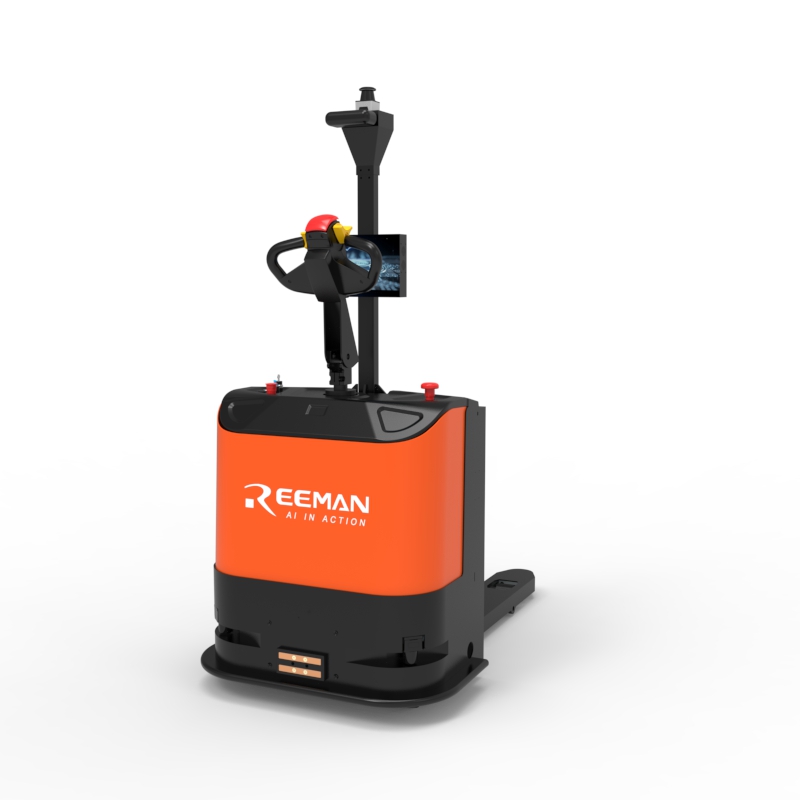
1500kg Laser SLAM AGV Forklift Single Line Lidar 30mm Navigation Accuracy 1019mm Forks 570mm Width Industrial Handling
A heavy-duty laser SLAM forklift for industrial handling. The 30 mm navigation accuracy and 1019 mm forks should be validated against your pallet openings, aisle clearances, and racking before selection.
- 1,500 kg load class
- 30 mm navigation accuracy
- 570 mm fork width
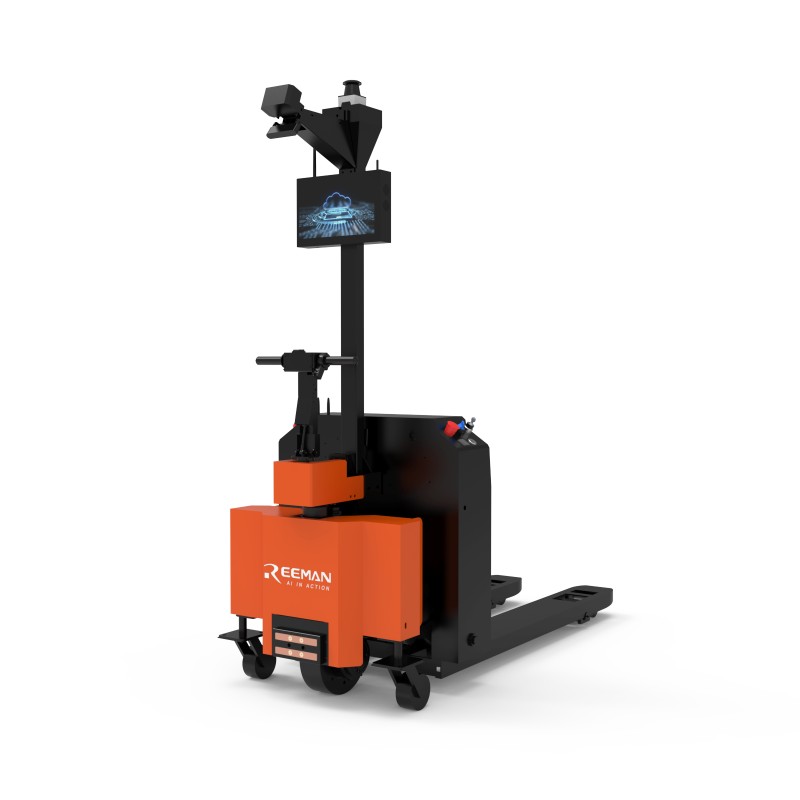
Reeman 2 Ton Autonomous Forklift AGV Laser SLAM Unmanned Pallet Truck 1085mm Fork 10mm Position Accuracy
For dense manufacturing and warehouse flows that need repeatable pallet placement. The 1085 mm fork and 10 mm position accuracy support precise pick-and-drop cycles, subject to a site survey and load stability check.
- 2T load class
- Laser SLAM guidance
- 10 mm position accuracy
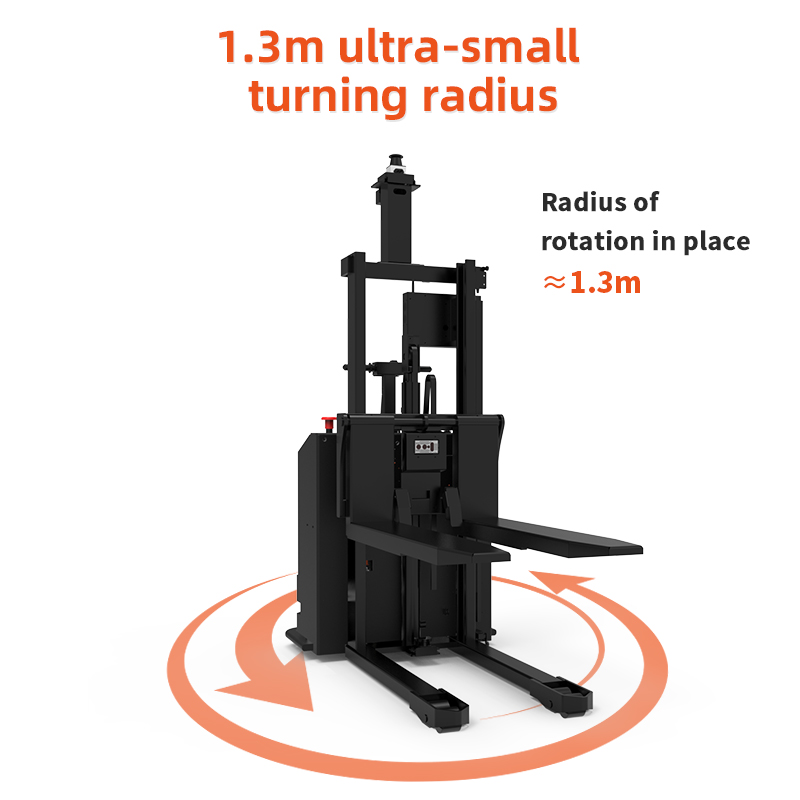
1000kg Forklift AGV Laser SLAM Navigation Pallet Transport Robot 1.3m Turning Radius Auto Charging for Factory Logistics
A compact forklift AGV with a 1.3 m turning radius and auto charging. It suits factory logistics and constrained floor layouts where pallet transfer must continue across shifts with minimal operator intervention.
- 1,000 kg load class
- 1.3 m turning radius
- Automatic charging
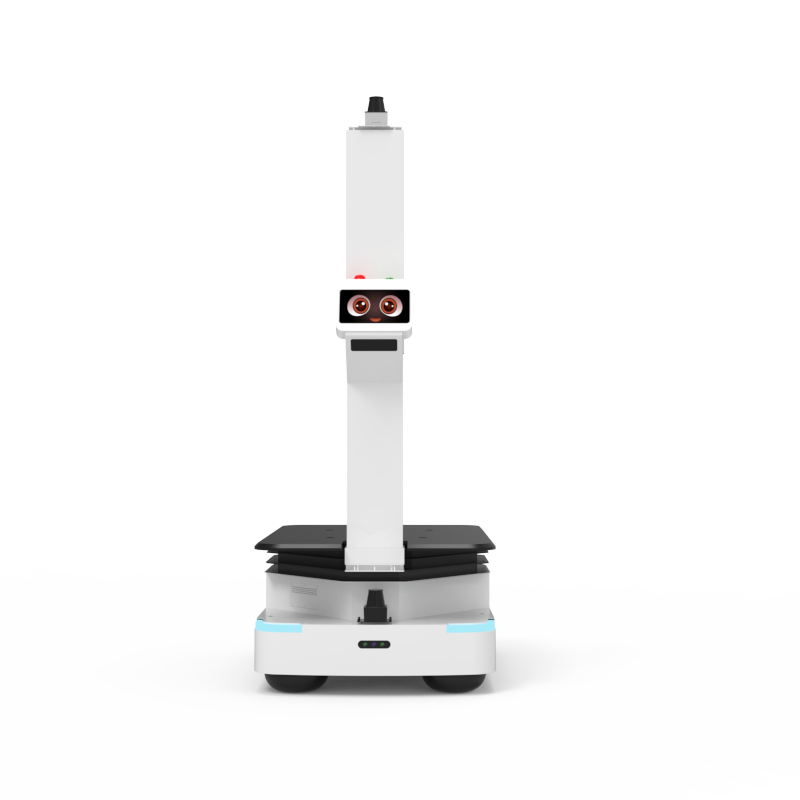
600kg Industrial AMR AGV Robot Laser SLAM Navigation QR Code-Free Factory Logistics
A flexible AMR for QR-code-free factory logistics. It is useful where routes change with production schedules and installing floor markers would disrupt daily operations in an occupied San Antonio building.
- 600 kg load class
- Laser SLAM navigation
- QR-code-free routes
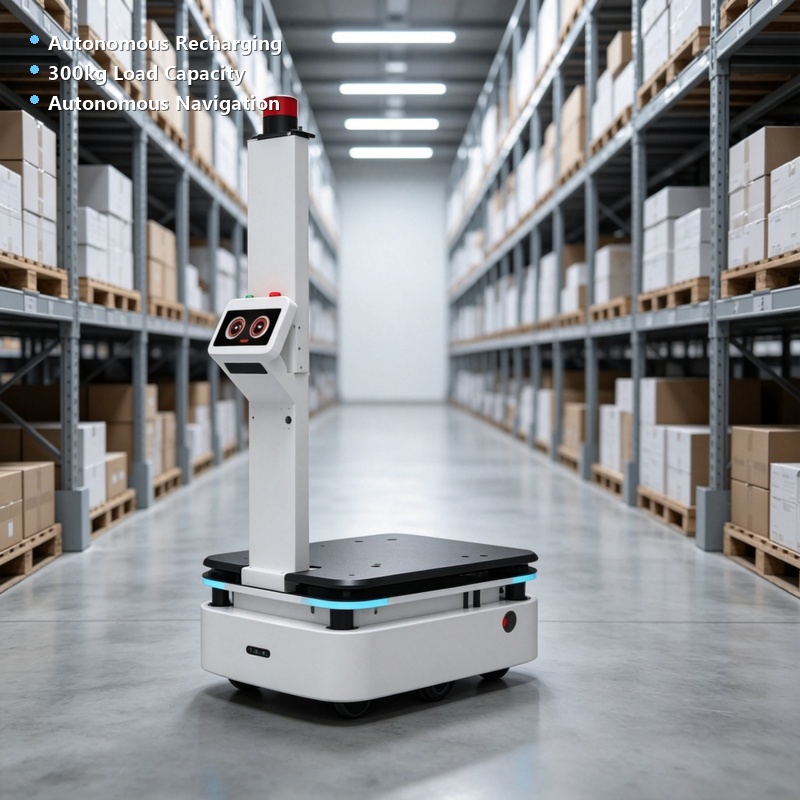
REEMAN Dual Laser Fly Boat MAX 300kg Industrial Delivery Robot for Manufacturing Plants and Factory Material Supply
A manufacturing-plant delivery robot for frequent material supply runs. It is best for repeated point-to-point movements such as kitting carts, parts bins, and consumables between storage and production.
- 300 kg load class
- Dual laser sensing
- Factory material supply
Factory Data San Antonio Buyers Can Actually Verify
E-E-A-T starts with facts a procurement team can audit. Elvorn combines in-house robotics engineering with production capacity, patents, certifications, and export support for North American buyers.
Factory data verified onsite by independent inspector SGS Group. Management systems certified to ISO 9001 and ISO 14001.
The Company Behind the San Antonio Shortlist
Shenzhen Elvorn Intelligent Equipment Co., Ltd. is a national high-tech enterprise focused on robotic platform technology and autonomous driving. We design, build, and support autonomous forklifts, industrial AMRs, robot chassis, delivery robots, cleaning robots, and disinfection robots. Our in-house R&D team owns laser SLAM navigation, motion control, fleet scheduling, and hardware, which shortens customization cycles and gives buyers transparent engineering answers.
Because San Antonio buyers often operate brownfield buildings, we focus on site-fit engineering rather than one-size-fits-all hardware. Before quoting, our application team reviews floor joints, door widths, aisle clearances, pallet condition, Wi-Fi coverage, charging locations, pedestrian traffic, and the WMS/MES touchpoints that will dispatch work. For projects near Port San Antonio, Loop 410, Loop 1604, I-10, or I-35, the same rule applies: first map the real flow, then size the fleet.
Factory evidence matters. Two production bases in Shenzhen and Ningbo support prototype builds, batch production, and export packing. Model-level CE, FCC, or PSE marks, SGS onsite verification, and ISO-certified management systems give San Antonio engineering and safety teams documentation to review before a pilot.
Two Production Bases
Shenzhen and Ningbo facilities support robot assembly, testing, and export packaging for North American orders.
In-House Platform Stack
Laser SLAM, motion control, fleet scheduling, and chassis design are developed by one engineering team.
Open SDK & API
AMR and chassis platforms provide APIs for task dispatch, status feedback, and secondary development.
Audit-Ready Quality
ISO 9001, ISO 14001, SGS onsite verification, and model-level CE, FCC, or PSE documentation.
 Engineering and R&D headquarters
 Robot assembly and production line
 Quality testing and engineering review
Why San Antonio Buyers Shortlist Elvorn
A workshop transport robot is not just a moving chassis. The supplier must prove navigation reliability, safety logic, integration capability, and long-term support for an occupied facility.
Laser SLAM Without Floor Disruption
Robots map the site and navigate without magnetic tape, floor QR codes, or reflectors. That matters in leased buildings and active San Antonio workshops where production cannot stop for floor reconstruction.
Open SDK and API Integration
Connect robots to WMS, MES, ERP, elevator controls, doors, and custom dashboards. Integrators can use the open SDK for secondary development instead of building a closed one-off workflow.
Payload Range from 300 kg to 2T
Choose from lifting AMRs, delivery robots, 1T to 2T autonomous forklifts, and 600 kg to 1,500 kg pallet platforms on a shared engineering philosophy for training and maintenance.
Multi-Layer Safety Architecture
Lidar, obstacle sensors, emergency stops, speed zones, and route rules help robots share space with pedestrians, forklifts, racking, and dock traffic in mixed-use facilities.
OEM, ODM and Buyer Label
Custom top modules, payload structures, branding, packaging, and software touchpoints are available for distributors, integrators, and private-label robotics programs.
Export-Ready Support
English documentation, remote commissioning, test records, spare-part planning, and FOB export terms support San Antonio buyers and their local integrators.
Where Workshop Transport Robots Fit in San Antonio
San Antonio’s industrial base spans fabrication, assembly, logistics, food processing, medical suppliers, aerospace-adjacent manufacturing, hospitality, and public facilities. Each environment creates a different material-flow problem.
Fabrication and Machining Shops
Move raw stock, fixtures, tooling, and work-in-process between saws, presses, welding cells, and finishing stations. Laser SLAM routes can be remapped when a job changes or a cell is relocated.
Assembly and Kitting
Deliver kits, bins, and carts to line-side stations on a repeatable schedule. A 300 kg lifting AMR or Fly Boat MAX delivery robot can reduce walking time and missed replenishment without blocking aisles.
Distribution, 3PL and Cross-Docking
For warehouses near I-35, I-10, Loop 410, Loop 1604, or Port San Antonio, autonomous forklifts can handle dock-to-stock, replenishment, and outbound staging with fewer empty operator hours.
Food, Beverage and Packaging
Transport pallets, cartons, and packaging supplies between storage and production. Buyers should confirm washdown policy, floor conditions, and traffic rules before selecting a model.
Medical, Aerospace and Defense-Adjacent Suppliers
When repeatability and documentation matter, route logs, status feedback, and controlled pick-and-drop points help engineering and quality teams review performance before scaling.
Retail, Hospitality and Public Venues
Dual-screen advertising robots can guide visitors, promote services, and support voice interaction in hotels, clinics, showrooms, and event spaces without permanent signage installation.
San Antonio Automation Trends Shaping the Next Buying Cycle
The strongest business case is rarely “replace every forklift.” It is usually “remove the repetitive, low-value travel that consumes skilled labor and creates avoidable safety exposure.”
Nearshoring Strengthens Regional Material Flow
As supply chains shorten across Texas and northern Mexico, San Antonio facilities handle more inbound components and outbound finished goods. Flexible robots help absorb volume swings without permanent conveyor changes.
Brownfield Automation Beats Floor Reconstruction
Most workshops cannot shut down for magnetic tape or QR installation. Laser SLAM lets teams map a route, run a pilot, and adjust without cutting concrete or closing aisles for days.
Labor Flexibility and Safety Drive ROI
Turnover, training time, and repetitive travel are persistent cost centers. Robots handle predictable transport loops so skilled staff can focus on setup, quality, and exception handling.
Connected Fleets Become a Procurement Criterion
Buyers now ask how robots report task status, charging state, faults, and traffic data. Open APIs and WMS/MES integration are moving from “nice to have” to a pilot requirement.
Workshop Transport Fit Index for San Antonio Facilities
This planning index is a discussion tool, not a guarantee. Final model selection depends on a site survey, load test, safety review, and integration scope.
High fit for 1T, 1.5T, and 2T autonomous forklifts when pallet quality and dock traffic are controlled.
Strong fit for 300 kg lifting AMRs and delivery robots where routes repeat and pick-up points are stable.
Best after validating aisle width, turning radius, rack clearance, fork dimensions, and pedestrian rules.
Fit for dual-screen advertising robots in showrooms, hotels, clinics, and event venues with predictable maps.
A Four-Step Review Before You Quote a Fleet
1. Load and Interface
Define payload, pallet type, cart or tote interface, fork dimensions, lift height, and whether the robot picks from floor, rack, conveyor, or custom stand.
2. Route and Floor
Map aisle widths, door thresholds, ramps, dock levelers, expansion joints, floor finish, Wi-Fi coverage, charging location, and pedestrian traffic.
3. Power and Safety
Confirm battery duty cycle, charging windows, electrical availability, emergency-stop plan, speed zones, and traffic rules for mixed forklift and pedestrian areas.
4. Integration and ROI
Estimate moves per shift, distance per move, load/unload time, fleet size, WMS/MES touchpoints, labor savings, safety improvement, and payback period.
San Antonio Workshop Transport Robot Procurement FAQ
These are the questions San Antonio operations, maintenance, safety, and procurement teams ask most often during first-round supplier review.
Can a workshop transport robot handle San Antonio concrete floors with joints, patches, or slight ramps?+
Do we need magnetic tape, QR codes, or reflectors?+
How do you support a San Antonio project if Elvorn is not a local San Antonio company?+
Can the robot connect to our WMS, MES, ERP, or local integrator dashboard?+
What trade terms and shipping approach apply to San Antonio?+
What compliance documents should a San Antonio buyer request?+
Can you customize payload, top module, color, branding, or packaging?+
Will Texas heat affect battery performance and duty cycle?+
How do we calculate ROI and the right fleet size?+
Request a San Antonio Workshop Transport Robot Catalog
Send your plant layout, maximum load, pallet or cart type, aisle width, floor conditions, target moves per shift, and WMS/MES requirements. Elvorn will return a model shortlist, fleet estimate, charging plan, and export lead time.
Get Catalog